
Rib Cage Mechanics 101
TL;DR
Your rib cage isn't a box. It opens on the inhale and closes on the exhale, and your muscles follow its shape.
Most lifters default to one of two shapes: compressed (flat front, stiff back, tight hamstrings) or expanded (big arch, pumped low back, ribs float up).
Compressed lifters don't need "ribs down." They're already down. They need to learn to fill the back and sides.
Expanded lifters do need "ribs down." Exhale first to set the ribs, then breathe into the belt without letting them rise.
Breathing drills won't give you a new skeleton. They teach pressure control and where to put air. Then you load the sucker.
Part 1: The Two Lifters
Everyone knows about the rib cage. It’s the container of some of the body's most vital organs, the prime driver of how air moves, including the anchor point of several muscles, and they all come in different shapes and sizes. My goal with this article is to show you why this matters and how about half of you are bracing wrong.
Most lifters default to one of two shapes. Neither is wrong. Each one is just bad at what the other is good at.
The compressed lifter. You've seen this one. Flat through the front, always looks a little "tucked" even standing around. Their hamstrings feel tight no matter how much they stretch. They hit the bottom of a squat and can't get a full breath, so they either cut depth or fold forward and grind it out with their back. Ask them to take a big breath and their chest lifts, but nothing happens in their back. This is a rib cage that never learned to open up in the back.
The expanded lifter. Very common in sports like powerlifting. Huge bench arch that looks effortless. The lower back is always "pumped" after leg day, even when they didn't train it. Their foot pressure feels like a ball rolling around on a table: they set up, take a breath, and the ribs float up and away from the pelvis before they've even started the descent. Ask them to brace, and they extend through the low back, because that's the only place they can find stiffness. Do they just need more core work? Maybe. What's more likely is they have a rib cage that can't depress.
Here's the part that matters. If you give both of these lifters the same cue, one of them gets worse. "Ribs down" to the compressed lifter is telling someone who's already clamped shut to clamp harder. "Chest up" to the expanded lifter is handing them permission to do the one thing they can't stop doing.
Part 2: Which One Are You?
Two quick tests. Neither is a diagnosis, but together they'll tell you which way you lean.
The thumb test. Lie on your back and place your thumbs on the bottom edge of your ribs on both sides, pointing up toward the sternum. Your thumbs make a V. That V is your infrasternal angle, or ISA. Wider than 90 degrees, you learn to expand. Narrower than 90, you lean compressed. That's a rule of thumb, no pun intended, not a measurement to live by. Plenty of people sit right at the border or dead in the middle.
The breath test. Put a hand on your sternum and take a big breath through your nose. Feel it rise? That's the upper ribs moving front to back, the pump handle. Now put your hands on the sides of your lower ribs and do it again. Feel them widen? That's the lower ribs moving side to side, the bucket handle. Then put a hand on your low back and breathe again. If the front moved a lot and the sides and back barely moved, you’re more compressed. If the sides and back filled easily but the front never really settled down, you lean more expanded.
Here is a checklist. Count how many you land.
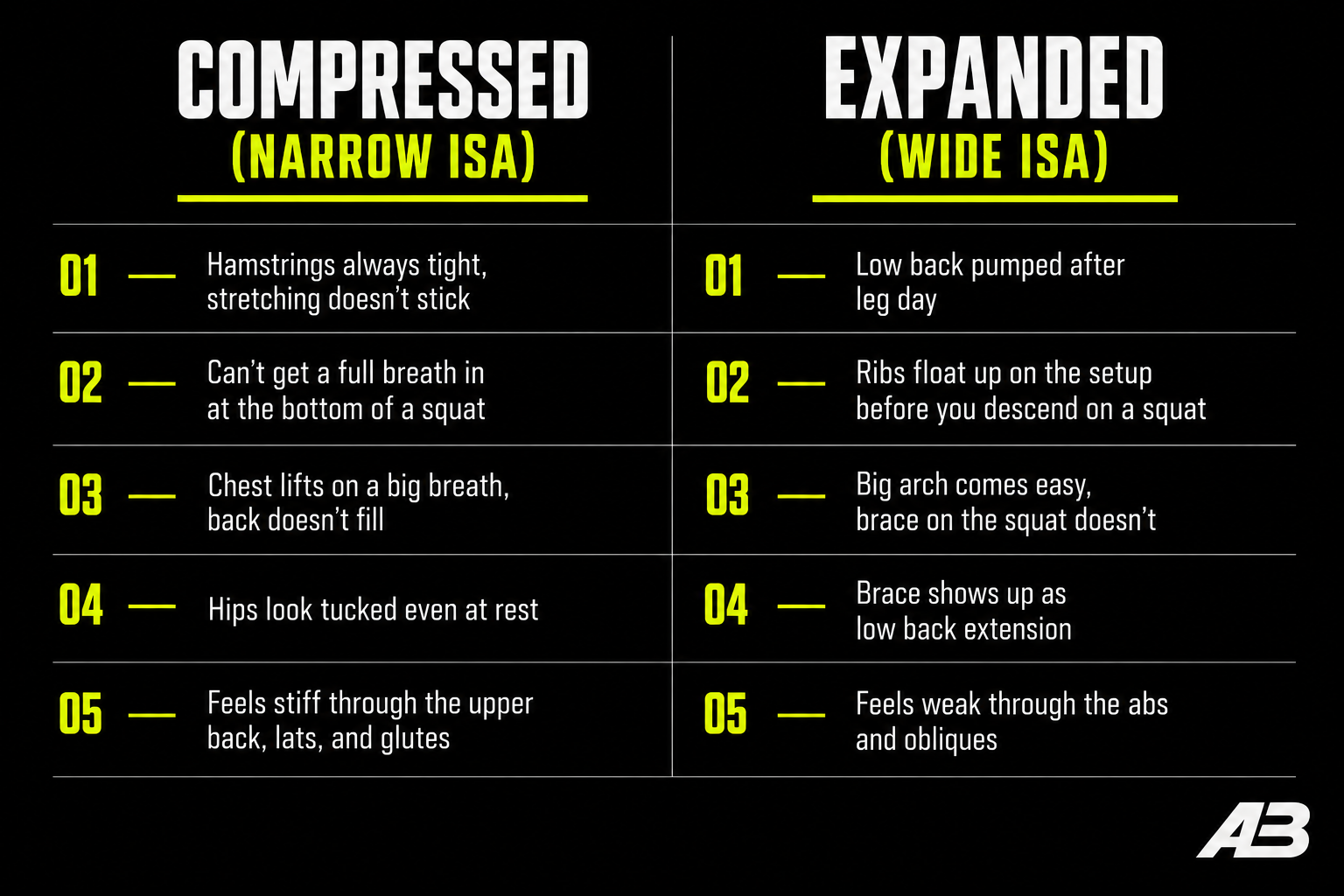
Three or more in one column and you know which section below is yours. Split down the middle? Read both. The point was never the label.
Part 3: What To Do About It
The rule is simple. If a lifter is compressed, give them expansion. If they're already expanded, give them compression. You're not fixing anyone. You're finding where they're missing capacity and building it.
If you're compressed (narrow ISA)
Your job is to learn to expand, especially into the back and sides. Get into positions that round the upper back and reach the arms forward.
Zercher squats and holds. Bar in the crooks of the elbows, arms wrapped around it. It forces the upper back to round and the hips to stay under you.
Anything heavy in the knees with the pelvis stacked. "Stacked" means ribs sitting directly over the pelvis, no tilt front or back. Front squats, goblet squats, heel-elevated work.
Back squats: fill the upper back with air. On the setup, breathe into the space between the shoulder blades, not the chest.
Chest-supported rows with a reach at the bottom. Let the weight pull your shoulder blades forward and your upper back round before you row. That reach is the goal.
Lat pulldowns with a huge reach at the top. Same idea. Let the lats lengthen, and the ribs widen before you pull.
Keep hinge work and horizontal pressing at lower volumes. Deadlifts, RDLs, and bench all reinforce the shape you already live in.
If you're expanded (wide ISA)
Your job is compression, specifically the front of the lower rib cage. Load the abs and obliques, and the ribs come back over the pelvis. If you can't find a rigid base in the abs, a wide ISA will borrow it from the lower back. That's why benching with a huge arch is easy and holding a brace on a squat is a nightmare.
Hamstring-biased hinges. RDLs and good mornings with the pelvis tucked under, not tipped forward. The hamstrings pull the pelvis into place, and the ribs follow.
Seated leg curls. Sit tall, ribs down, and let the hamstrings do the work without the low back joining in.
Loaded ab and oblique work that keeps you stacked. Side bends, hanging knee raises, cable crunches. The goal is ribs over pelvis under load.
Own the stack before heavy overhead pressing. Overhead is where an expanded lifter's ribs flare the most. Own the position on an incline before going overhead.
The cue that works. Exhale first to set the ribs, then inhale into your belt or brace without letting the ribs rise. That's the whole brace.
Will your ISA angle change? Maybe, maybe not. Will you feel better? Absolutely. The goal is to move the air, not to change the angle.
Part 4: Why This Works
You understand what to do. Here's the why, for the people who want it.
The rib cage moves. It isn't a rigid box that gets left wide open or clamped shut. It's 12 pairs of ribs that attach to the spine in the back and the sternum in the front, and they move along two axes. The upper ribs swing front to back like a pump handle and drive the sternum's rise and fall. The lower ribs swing side to side like a bucket handle and change how wide you are. You felt both of these in the breath test.
Air drives the movement. On the inhale, the diaphragm descends, abdominal pressure rises, and the ribs flare open to make room for the lungs. That's expansion. On the exhale, the diaphragm rises, pressure drops, and the ribs close back down. That's compression.
Muscles follow the shape. This is the part that should make you care. The pecs, lats, obliques, and erectors all attach to the rib cage, so a full inhale or a full exhale changes their length and tone. Rib cage shape is set by where the air goes, and muscles follow the shape. If you want to change how someone's trunk moves, starting with the breath makes a lot more sense than "squeeze here."
The ISA is a proxy, not a cause. A narrow ISA is an exhale-biased shape: it compresses easily and struggles to push air into the back and sides, which is why those lifters tend to run a stiff posterior chain. A wide ISA is an inhale-biased shape: it expands easily into the back and sides and struggles to compress the front, which is why the low back extensors do all the work and the abdominal wall does none. The angle doesn't cause any of that. It just tends to travel with it.
The real variables are the four regions. Upper, lower, front, back. When air comes in, where does it go? If a lifter can't drive air into one or more of those regions, they have a limited rib cage, and there are positions they're going to struggle with. It doesn't have to be "corrected" or "balanced." It's a lens for finding the missing capacity, not a label the lifter walks around wearing like a scarlet letter.
Part 5: Where These Models Overreach
A model that isn't open to critique isn't a model. It's a belief. A belief doesn't need evidence, just acceptance, whether that comes from experience or intuition. A theory needs real evidence, and there are a lot more beliefs in fitness than theories. The ISA model is closer to the first group than the second. The wide and narrow archetypes appear in the literature, but the training heuristics built on top of them are extrapolation, not data.
Breathing drills don't change the shape of bone. They can change how you look, briefly, and how you function. They can shift resting muscle length enough to open up range of motion at a joint. That's a change in tone and available motion, not a remodeled rib cage. Anyone selling you a new skeleton is selling snake oil, and you should run.
Where I actually see breathing and positional work fitting in is smaller than what gets sold, but more useful than the people who write it off want to admit. It does three things.
It teaches pressure control under load. That's the difference between a brace that holds on a heavy last rep and one that falls apart the second the bar gets heavy.
It teaches you where to put air. If you default to filling the front, you learn what the back and sides feel like, and vice versa.
It improves how the ribs move, which usually shows up as a spine and hips that suddenly have more room to work with.
That's it. That's the list. It won't fix your technique, it won't replace lifting, and it definitely won't give you a new rib cage. But if you need a lifter to get into a position they can't currently find, it's one of the best tools I've got. Limited in what it does. Real in what it does.
Conclusion
You're not training the rib cage here. You're learning the strategies your body doesn't tend to favor, and building the ability to move air into whatever area the task needs. So next time you have a mobility problem, or you keep straining the same muscle, look at how you're moving and the shapes you can and can't make.
Fix the distribution and most things start to sort themselves out.
Also, don't forget:
Load the sucker!